

Experimentation
Over the last few months I’ve had more time for experimentation, a certain amount of navel gazing, and self-determined activity.My camera collection has both swollen and shrunk, I’ve experimented with new editing hardware, and I’ve learned some new techniques.
My eventual goal, which was interwoven through these experiments was the chance to bring my dormant 4×5” camera (my Tachihara Hope) out of hibernation.
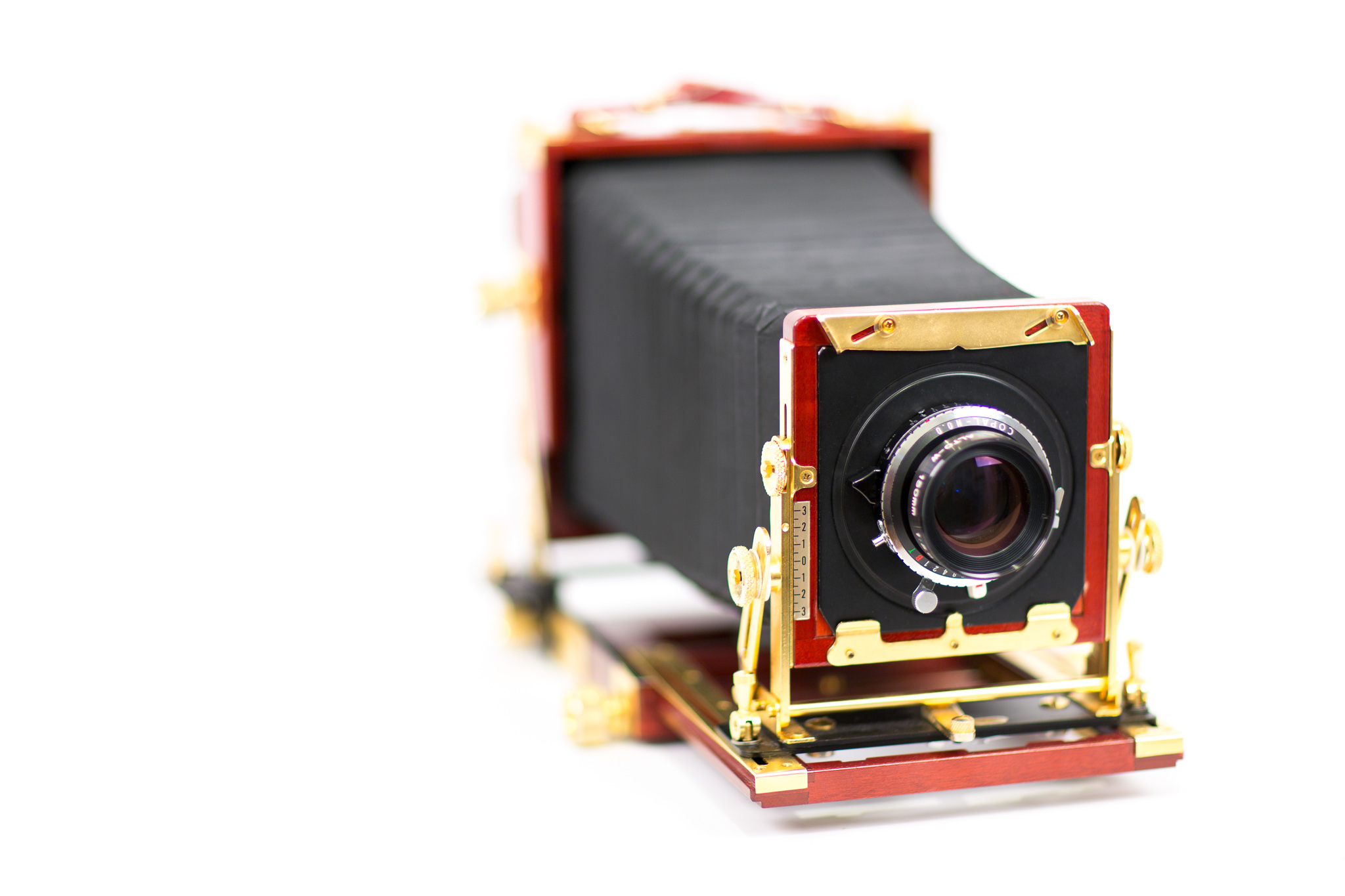
I didn’t quit, I just stopped
I returned to film for fun, and to pay my dues. As my digital cameras became workhorses, my film cameras became more akin to dressage ponies, and by the time my son was born, I’d amassed a respectable collection of cameras and paraphernalia.
Having given over a hemisphere of my brain, some of my house, and most of my time to photography, fatherhood was going to require some sacrifices. As I wasn’t going to stop shooting film, the decline in available time meant making some changes.
Switching to lab processing for 35mm and 120 film meant most of my cameras remained available to me. I would still have the Jobo and the Tachihara when I wanted them. The short version is I didn’t decide to stop shooting large format, I just didn’t do it anymore.

Galleria (2015) – Tachihara Hope – Kodak Portra 400
The Joy of LF
For the uninitiated, large format photography offers you huge resolution combined with movements. Tilt, shift, and swing enable the lens and the focal plane to be adjusted independently of each other to control composition, shape, and depth of field.
It isn’t hard in itself, but it does require a deliberate and considered approach. There are many more opportunities for failure and a moment’s carelessness can cost you your pictures.
It is the combination of that challenge and the possible results that drew me to large format photography in the first place. Slowing down, working to a method, measuring twice and shooting once, it all appealed to me. Plus, when you get it right, the results are a delight.
My last outing with the Tachihara was in 2016, I had issues with light leaks and technique that I meant to address but didn’t come back to.
In 2018 I did a large format photography workshop with Giulio Speranza in Rome with his Linhof Technika IV. These were my last large format pictures and they reignited a passion that, on reflection, I didn’t feel I had time for.

EUR – Linhof Teknika – Ilford Delta 100
Back in the saddle again…
Having tested the processes and equipment I would need, I was ready to try large format again. Eventually I had to bite the bullet and check the camera for light leaks and mould. A cursory inspection left me feeling confident, it was time to have a go.
Given that going out with it wasn’t allowed at the time, I bought an orchid and an oriental lily at the supermarket. As I can load 6 sheets into my 4×5” Jobo reel, it made sense to shoot the flowers in two batches, six of one, and then six of the other. I lit the flowers with modelling lamps and made the following. The fire was alight once more.
Lily – Tachihara Hope – Ilford HP5+

Orchid – Tachihara Hope – Ilford HP5+

Orchid – Tachihara Hope – Ilford HP5+
Through the pinhole
Now that everything was working nicely, I spied a Harman Titan 4×5 pinhole camera in my local camera shop. I made a pinhole lens for my DSLR about ten years ago, and having not used one since, seeing this one peaked my interest.
The fact that I had a process in place meant having a go would be almost frictionless; the Jobo was working, I had sheet film and chemistry ready to roll, there was almost nothing to stop me.

Sunflowers – Harman Titan – Ilford HP5+
Not what it is for
It makes sense that the first thing I would use the Titan for would be studio photography, something it really isn’t intended for. I was intrigued by the possibilities, and going out wasn’t really possible.
I’ll spare you the calculations, but after some testing with a DSLR and a filter, I was happy that two 400w strobes would provide adequate light for an exposure at f/206.
Sitting between a pair of opposed 400w strobes, made for quite the shooting experience. It was bright and hot enough to dissuade me from trying to photograph my son the same way.
As I was due for my first haircut in four months that day and decided to grab a before and after. I also threw some sunflowers in to see how they would come out. I push-processed the film by 1/2 a stop, suddenly second-guessing my calculations, but it worked, and made for an interesting look.

Before – Harman Titan – Ilford HP5+

After – Harman Titan – Ilford HP5+

Pinhole Studio
A little reciprocation
The pinhole camera has an aperture f/206 which is tiny. It means that you have uniform clarity from front to back in your image, you also tend to use long shutter speeds.
Reciprocity failure is the point at which the relationship between aperture and shutter speed breaks down. For many film stocks, once you have to expose for longer than a second, (it’s night time, you have a pinhole lens, you are using a filter), there aren’t going to be enough photons hitting the film to suitably traumatise the emulsion and create the picture.
For each second you lengthen the exposure, you also have to allow some extra time for the chemistry to do its thing. Ilford publish their reciprocity failure rates as a factor, which makes this calculation easier, (many companies simply offer a graph).
I built a spreadsheet for use in the field which would convert a standard exposure into one for the pinhole camera, and then extrapolate an exposure length which included the reciprocity failure. (I love spreadsheets).
1/125th @ f/5.6 would require 11 seconds @ f/206
11 seconds adjusted for reciprocity is 23 seconds at a factor of 1.31 (Ilford HP5+)
In the (a) field.
A few days later I was walking with friends through an unfamiliar meadow. At the top of a rise stood a single and rather grand tree. The grass had been allowed to grow during lockdown and was above knee height.
It’s common in coastal photography to use a long shutter speed to juxtapose the movement of the sea with something solid and stationary, like a dock, rock or jetty.
I’ve wanted to take an equivalent photo inland for ages, utilising moving grass or crops to take the place of the sea, and something ardent and constructed in the background as my counterpoint.
The time has never been quite right. The crops are too short, the wind too light, the buildings in the background not quite picturesque enough. If I ever do stumble across the perfect combination I am without the relevant gear.
This tree would suit nicely. Granted it was not a white episcopalian church nestled in a group of poplars, but it was solid, stationary, and suitably ardent.
After a few false starts I finally got back to the meadow to make this photo. Only to find that the grass had been mown. In the previous 24 hours.
Downhearted but standing there, holding a camera, it seemed like a good opportunity to test the box of expired Ilford Delta 100 I had found in the in the cellar. It would also be a chance to test the camera and spreadsheet before trying anything else.
The result is pedestrian, and would have been improved by a sea of waving grasses in the foreground. It did however confirm that my sums and the film were working.

Coming to a head
Once I realised the spreadsheet was working nicely, I noted how easy it would be to adjust for use with filters. Some messing around in Excel and the Lee Filter app enabled me to include a dropdown menu of filters. I could now calculate exposures for use with my little, big, and super stopper.
Having not really engaged with reciprocity failure before, I was suddenly ready to shoot large format film with a 10 stop filter.
When I need to justify the number of cameras I own both to myself and others, this is the kind of feedback loop that helps. Getting to grips with the Titan has helped me reengage with my Tachihara in a way that I wouldn’t have predicted.

Bunker – Canon 5dMKIV – 17mm TSE
Bunker Fixation
Having now done the processing and the work with reciprocity failure, I now felt ready to bring it all together. A recent trip to France gave me a chance shoot the Tachihara with an ND filter for the first time.
We were staying in a town just up the beach from a remarkable relic of World War II. In 1994 erosion of the cliffs had rendered the bunker a hazard to walkers beneath. The decision was made to drop it onto the beach.
After partially undermining it, the local fire brigade used their hoses to erode the cliff beneath the bunker until it fell onto the beach below. Instead of breaking apart as other bunkers had, it survived the fall and remained vertical, standing on the beach.
In the 26 years since, the cliffs behind have eroded, and it now stands in the middle of the beach, 30m from the cliff wall.
I visited the bunker early in the trip to survey angles, light, and wind. I worked out where I might park, how far I would need to lug the cameras, and what sort of tide I would want.
I was absolutely going to shoot the bunker with the Tachihara, and blur the sky and sea with a filter.


Survey images – Canon 5dMKIV – 16-35mm f/4
Anxiety – Method – Gay Abandon
I felt a genuine sense of anxiety as I drove out to use the Tach in the field for the first time in so long. The film I was going out with was out of date, as was the chemistry that would greet it in England. The spreadsheet I was going to use was untested for colour film, and it had been a long time since I’d used the camera in the wild.
My chosen photo was of the bunker with the sea behind. I chose it partly because I wanted to blur the sea and sky, and because I could set up in the lee of the cliffs, out of the wind.
The first shot was a straight shot, a little tilt and shift and f/32. Just in case the long exposure didn’t work. The second was the same, but with a 10 stop filter. I was now going for a 4 1/2 minute exposure, which is a long time to keep everything still.
The camera is not aerodynamic. It is also more cumbersome that it is heavy. The wind rose during the exposure and I did my best to shield it. As I would discover later, I was not successful.
The anxiety initially gave way to methodical focus, which then gave way to gay abandon. I shot the rest of my colour sheet film that afternoon. A few were long exposures and some were quick shots that required a lot of waiting, finger on the plunger.
Concerned that I would come home with nothing, I shot the bunker with my Canon 5D. This meant I could utilise my 17mm TSE, work more freely, and be less worried about the wind.

Bunker – Tachihara Hope – Kodak Portra 400

Still life with large format camera and inverted bunker
Bunker – Canon 5dMKIV – 17mm TSE

Bunker – Canon 5dMKIV – 17mm TSE

Bunker – Canon 5dMKIV – Irix 11mm f/4
Holy Camera
The pictures from the Tachihara were wrecked. Of the six photos taken only the first shot of the bunker survived. Initially suspecting the dark slides, I reinspected the camera with a high powered torch and found pinholes in the camera’s bellows.
Tiny but plentiful they aren’t a problem in shade or in a dark studio. They will however ruin film that is either exposing for a long time, or while you’re waiting for someone to stand in the right place, or ride past on a bike.
I did not take the failure of the photographs well. I’m embarrassed to say that oaths were made, threats were inferred, and toys were ejected. A brief moratorium on all film photography was threatened, and some sulking took place.
A thorough inspection of the camera might have spared me significant hassle and heartbreak and stopped me ordering more sheet film before I left the UK.
Upon my return and before I found the fault, I parted with the Titan. I reasoned that I prefer the pictures from the Tach, and as they are almost equally complicated to shoot overall, I may as well shoot the Tach.
This leaves me with ample film, and no camera. I can shoot at night, in the studio, and take quick snaps, especially if I drape a dark blanket over the camera, but I need new bellows.

Sunset – Fujifilm GW690III – Kodak Ektar 100
In terms of extracting the positive, I know where the issues in 2016 arose. I know that the exposure sheet is working as expected.
On our trip to France I made images I really like with the EOS 1, Ricoh GR1, GW690III, and the 5d mkIV. It does beg the question, is there a need or even room for large format?
As things start to open up and go back to normal I hope to be busy with work. There hasn’t been time in the past, does spending money on the camera makes sense?
I honestly don’t know.

Path – Fujifilm GW690III – Kodak Ektar 100

Expanse – Fujifilm GW690III – Kodak Ektar 100