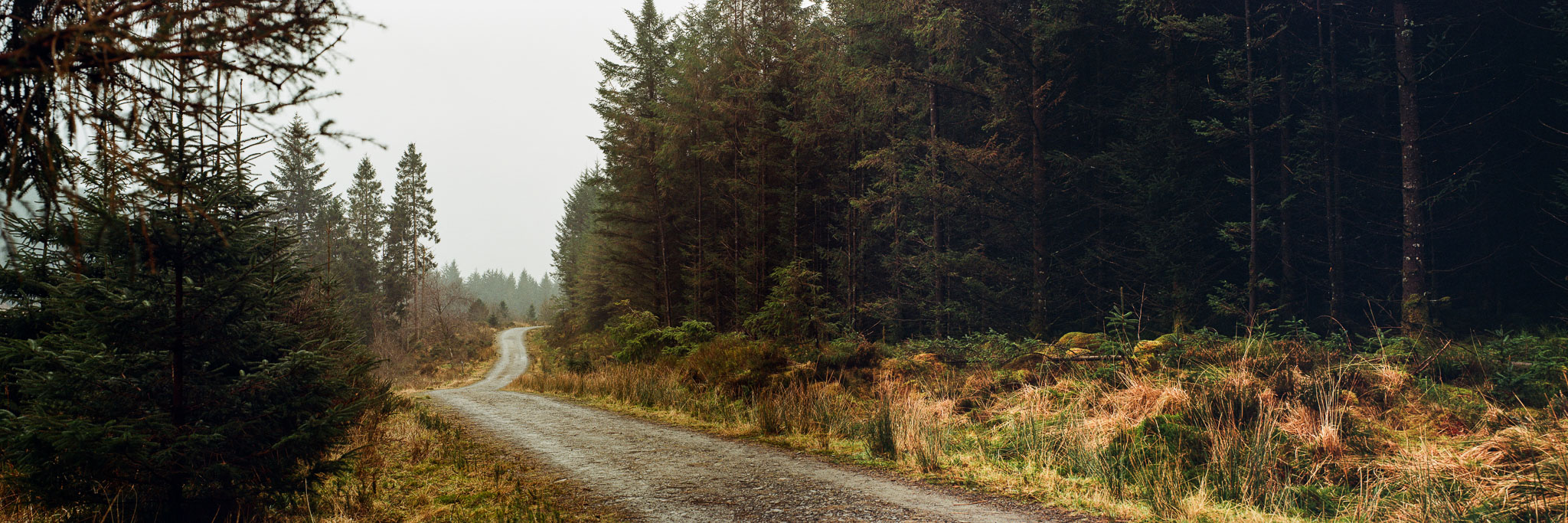
Fujica G617 – Kodak Gold 200
A Journey
The last 18 months have seen me complete on some long term life goals. Alongside some of the larger ones, completing a masters, formalising my role as an educator, I’ve also been pushing ahead with some of the smaller ones. These have included shooting large format transparency film, orchestrating some more time in the woods with some bears, and finally getting my hands on a panoramic camera.
Taking delivery of my Fuji G617 was the culmination of a journey the seeds of which were planted 9 years ago. When my friend Gareth bought a Tomyama 6×17 flat-back, I realised that I needed one too. Not just in the standard, ‘nice-thing-want’ reaction that I often have. There was something deeper going on.
At the time I had just started swimming around in the waters of large format, I’d not long bought my Tachihara, and within a few months I bought my Leica M4-P. This was more than enough investment and a steep enough learning curve to be going on with. The need for panorama was pushed to one side.
Confronted with the Chroma Six:17 at the Analogue Spotlight meet-up in October of 2023, the need came back to the fore in a hurry. I nearly bought one there and then. What followed was a dive in to the world of panoramic photography, as I tried to figure out what I needed and how much that was going to cost.

Fujica G617 – in its case

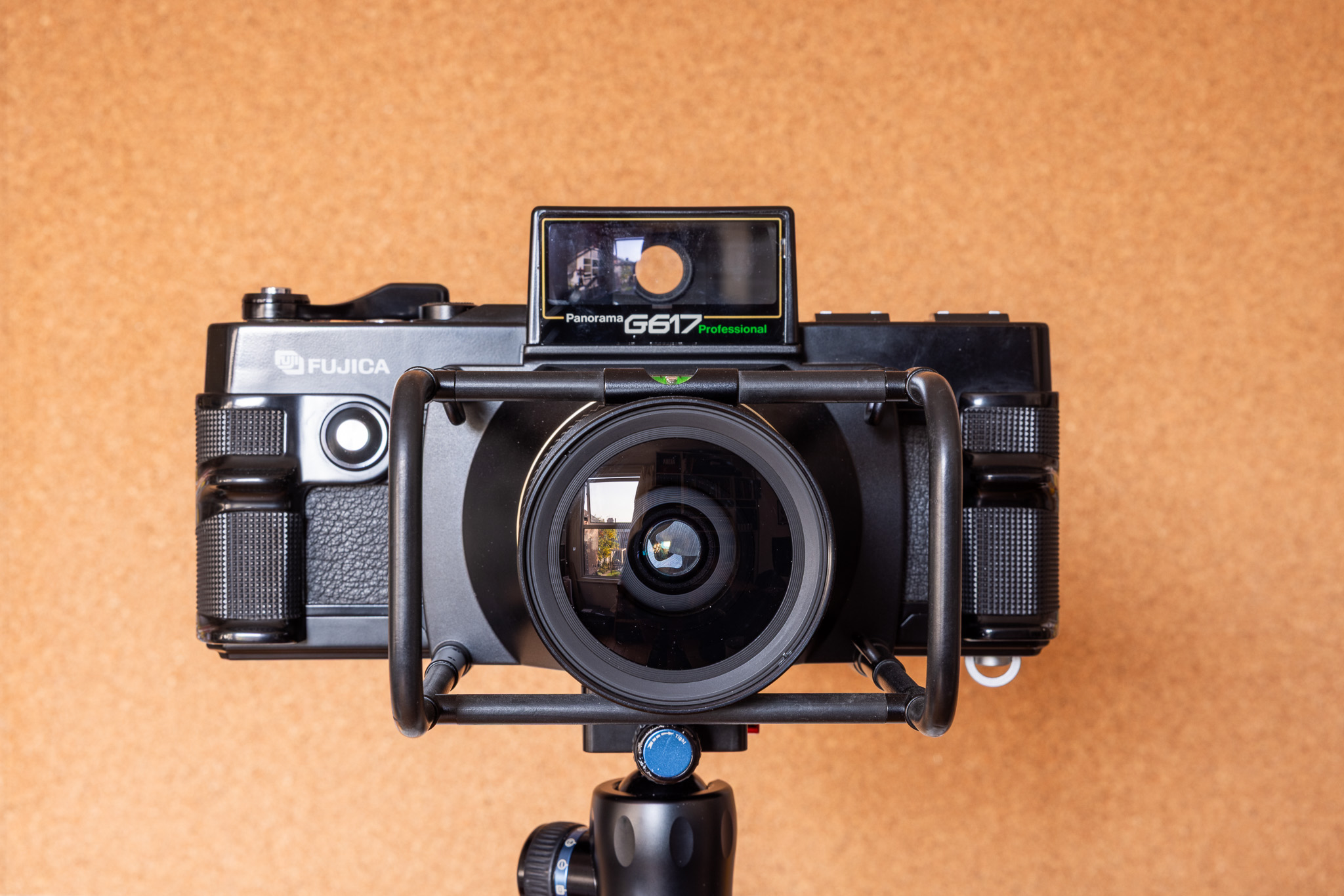

With filter, Naked, and with hood
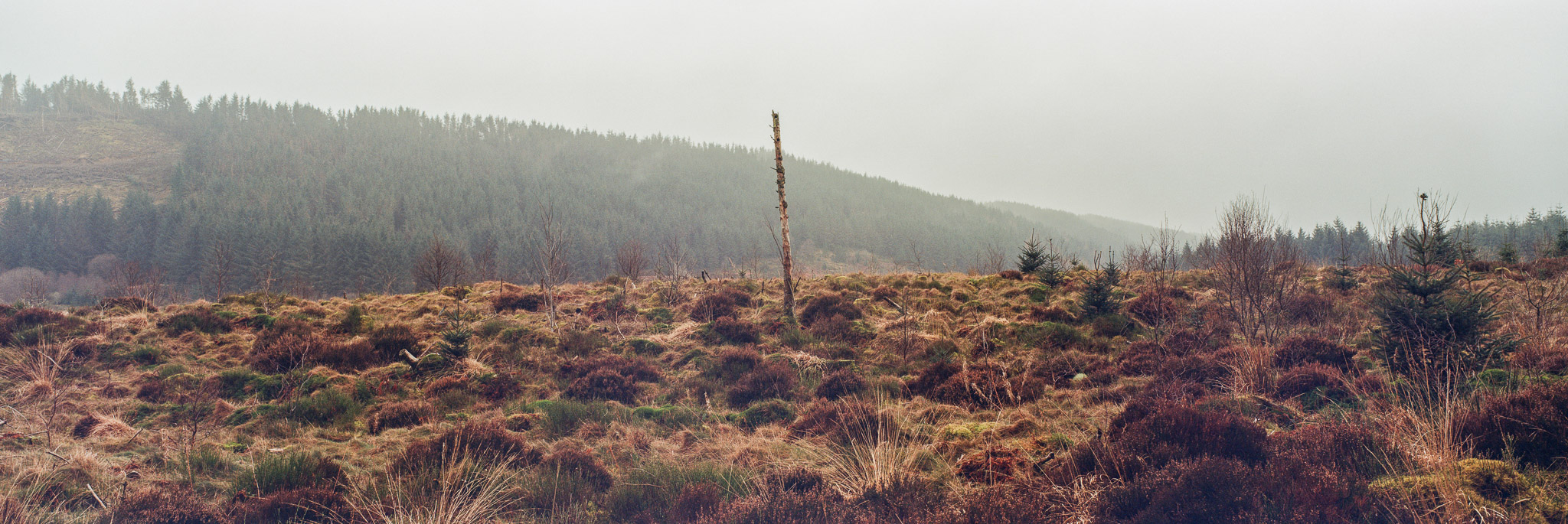
Hafren Forest – Fujica G617 – Kodak Gold 200
Panoramic Photography
For the uninitiated, panoramic photography (as wikipedia describes it) tends to cover a field of view of 160 degrees or greater, and have an aspect ratio greater than 2:1. The suggestion is that it needs to be both long and wide to be considered a panorama*.
Historically panoramic photography has utilised everything human ingenuity could throw at it. The image could be made by rotating the camera in time with film being slid across the focal plane, or rotating a lens in front of stationary film on a curved plane. Both the digital and analog eras have seen panoramas produced by stitching multiple images together, and these days camera phones and compacts can render them in real time.
<p>The ultimate, uber, giant slaying, king of the hill, untouchable, winningest option in my opinion would be the panoramic view camera. Now you have rise and fall, tilt, shift, and swing to add to your panoramic composition. They also use a focusing screen that enables you to confirm focus for each photo.
If all of the rotating, mechanised, swinging cameras are German or Japanese sports cars extracting as much performance as possible from their 3 litre power plants, and the view camera is some kind of hybrid electric/dilithium powered monster digger, then the flat-back is equivalent of a whacking great v8, plonked into a little deuce coupe.
Just take a massive large-format lens and hang it in front of some 120 film. You’re only using a slice out of the middle of its image circle, but what a slice.
*While this might be broadly true, it is belied by both the 45mm and 90mm lenses for the Hasselblad XPan, neither of which come close to 160 degrees, and the XPan is without doubt a panoramic camera.
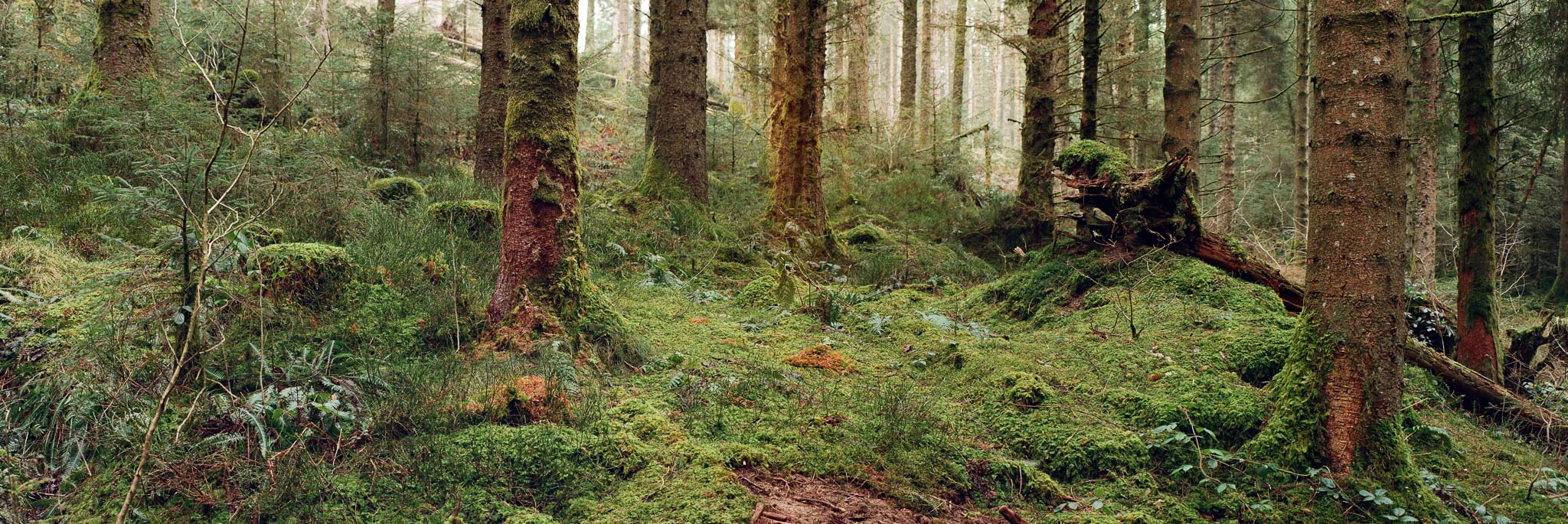
Some rise would have been nice here – still ace… Hafren Forest – Fujica G617 – Kodak Gold 200
I was immediately taken with the flat-back solution. They’re more plentiful, relatively speaking, and are generally simpler and more reliable.
They offer reduced distortion and ease of production. Click the shutter release and voila, the image is made from a single perspective and in a single moment. No ghosts, no stitching, just massive resolution and your subjects are roughly the right shape, (rotating lenses do terrible things to architecture).
There are a number of options in the flat-back arena. You could go for the Hasselblad XPan which is the only full format panoramic camera for 35mm. Then in 120 there’s the Chroma, Linhof, Tomiyama and so many more.
The Hasselblad was relatively easy to discount. They’re getting rarer, are commanding massive prices, and can cease operation at a moment’s notice thanks to their ageing electronics.
The Chroma looked amazing, but some inner bias against 3d printed cameras stayed my hand. The medium format options were all expensive, with a range that started at pricey and went all the way to Linhof, and I couldn’t find a UK distributor for the only 6×17 view camera I knew about, the Shen Hao TFC617-A.
So the decision was made. Probably a flat-back, possibly a view camera – now I just needed one to fall into my lap.
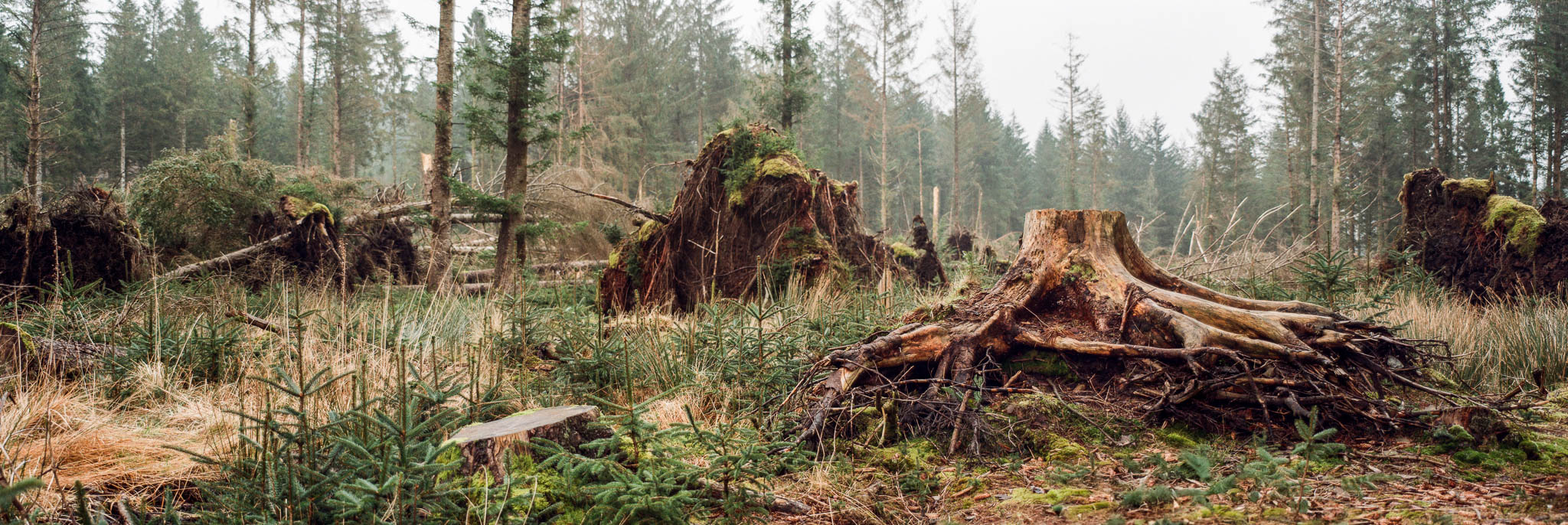
The Felled and the Fallen – Fujica G617 – Kodak Gold 200
Maslow’s Hammer
When I said there was more going on than just ‘nice thing want’, it genuinely wasn’t just GAS or a lust for a sexy new thing.
Abraham Maslow argued that: “If the only tool you have is a hammer, you tend to see every problem as a nail.” The tool that you have, the tool that you know, changes the way you view a challenge, project or subject.
“Your camera takes great photos” is a line that all photographers love to hear. The implication being that they had little to do with it. While it is true that none of my cameras make great images if i’m not around to help, I also struggle to make photographs if I don’t have a camera with me.
In the relationship between human and tool, there is a tendency to see ourselves as possessing all of the agency, after all, we are alive and our tools are not. It’s easy to forget that to get the camera to do what we want, we have to know and understand the camera. The physics we engage with when we make photographs, the physics that govern how light passes through a lens, are no more under our control than when golden hour is going to happen.
Knowing how a machine works and being able to manipulate it to our own ends, does not negate the limitations of that machine, and thus the limitations placed on outcomes from that machine.
Once we have learned how to work within the confines of a camera’s capability, it’s agency becomes part of our process, and it becomes subsumed within our own.
I work more slowly and take a more considered approach when I work with a film camera, this is an effect of the camera on the photography. When my camera has a portrait viewfinder I make more a higher proportion of portrait images. Eye detection autofocus has has a profound effect on the way I create my commercial work.
I am a different photographer when I shoot my large format camera, than I am when I’m making an image with my phone.
It’s this symbiosis, this ‘powers combined’ that keeps me exploring formats and trying new hardware. It’s my belief that there might be a camera or a format out there that, once I have it in my hands, would create a gestalt that would allow my practice to evolve.
It was this desire that kept a panoramic camera on my wish list. There is always the argument that shooting all sorts of cameras and formats, flitting from one thing to another could undermine the creation of a special relationship with one. It might well be true, but I’m still trying to find my soul camera, to find what Henri Cartier-Bresson called “the extention of his eye”.
This section, and my subsequent justification for buying the G617 owes a debt to my likely misunderstanding of the work of anthropologist Tim Ingold on agency and materialism.
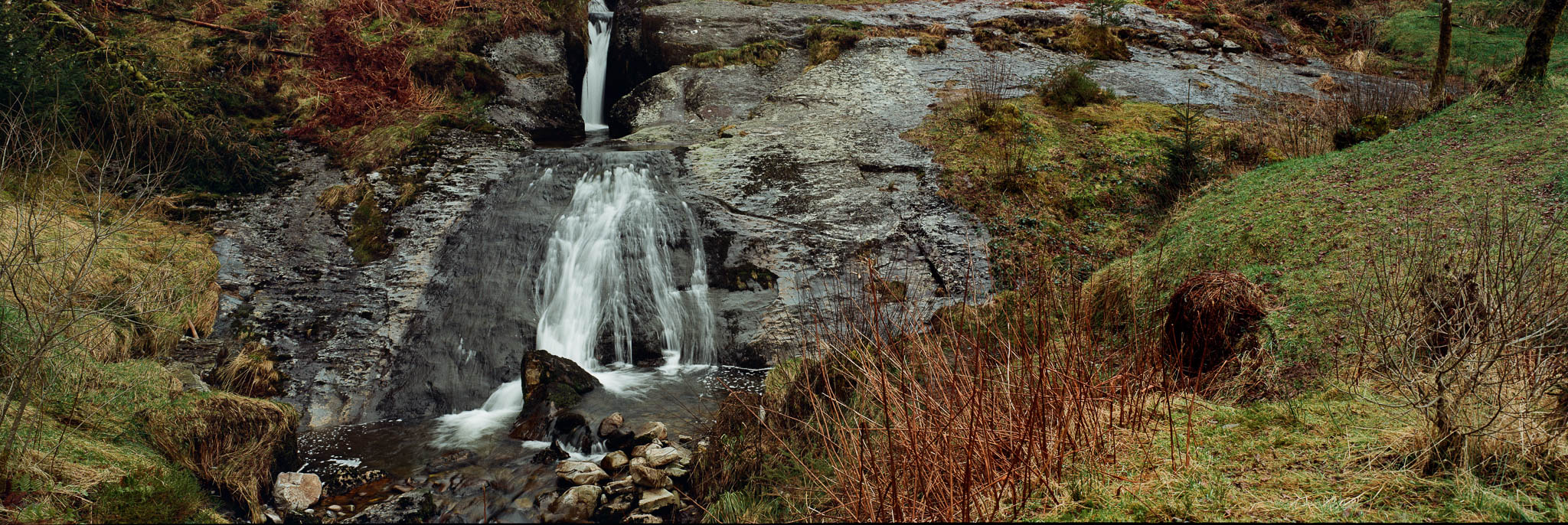
Fujica G617 – Kodak Gold 200
Buying a Flat-Back
I watched items and vacillated, wondering where my bias against 3D printed cameras came from. My ‘problem’ was solved when a friend pointed me at a nice Fujica G617 at London Camera Exchange in Oxford.
It came out in 1982 with a fixed 105mm f/8 large format lens. It gets four 6×17 frames to a roll of 120 film. It arrived complete with a hood, a sturdy case and a centre grad*. A nice self-contained chemistry set that was perfect for a little experimentation.
*The centre grad filter is a Neutral Density filter that blocks a stop of light in the centre of the field of view, reducing to nothing evenly as you move out to the edge of the frame. They counter the natural vignette (darkening of the edges and corners) that happens when using a lens at the limits of its image circle.
They are phenomenally expensive when bought separately due to their rarity and the waste rate in manufacturing, getting one with a camera was a god send, and was one of the justifications for buying a Fuji.
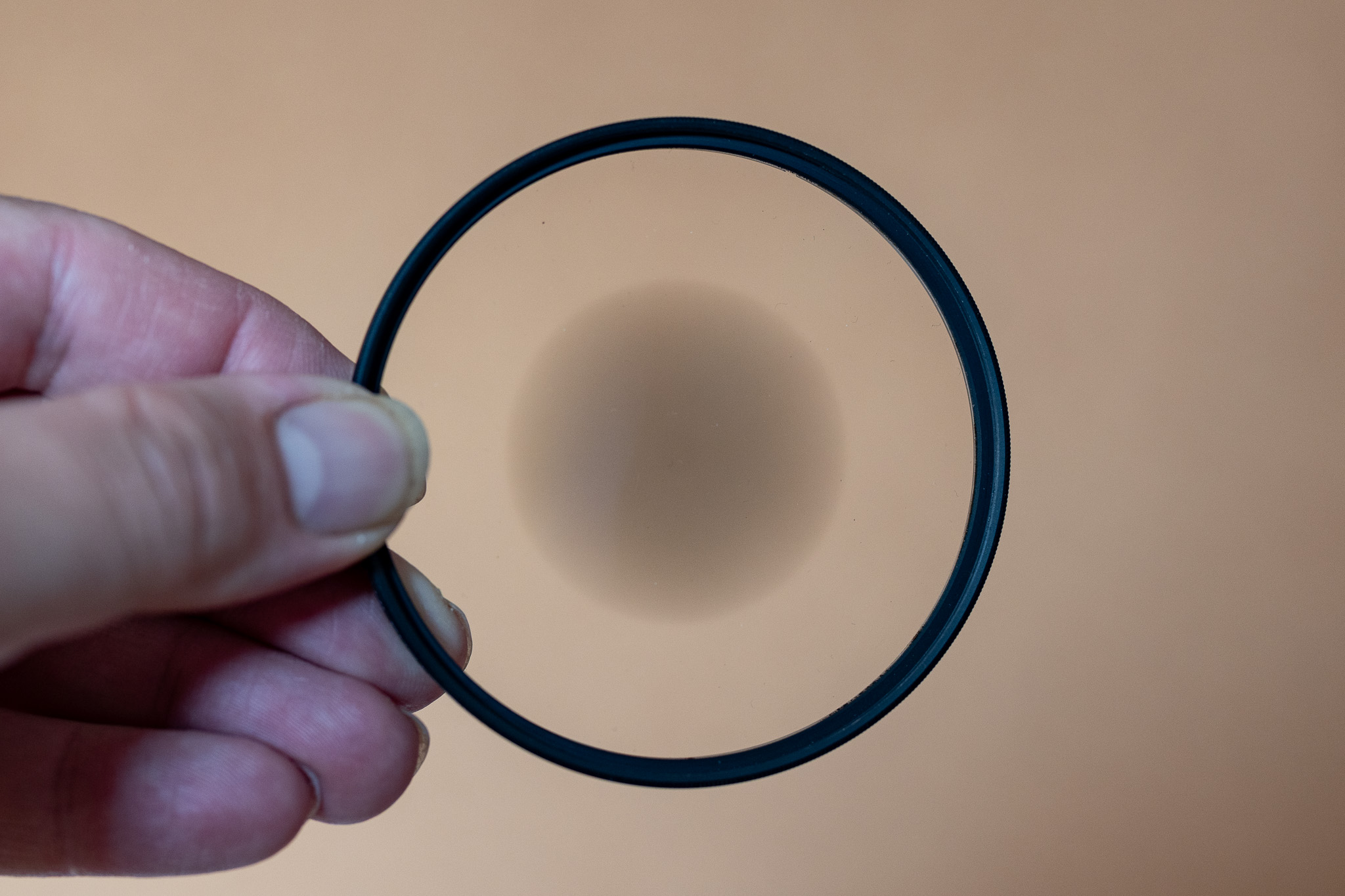
One-stop Centre Grad filter for the Fuji 105mm f/8 lens
One downside of the flat-back route is the lack of focus confirmation, you just have to work from the focusing scale on the lens. Having had some poor experiences with zone-focus in the past, I was worried that I’d fail to estimate distance to my subject and have soft or back-focussed images.
To combat this I took an LD Meter by CHI with me on our first outing to Hafren Forest. It’s a combination light meter and laser measure which gives you both an exposure measurement and a distance to target.
As a result, while I had some other issues, none of my images were mis-focused. (You can read my review of the LD Meter by CHI for 35mmc here).
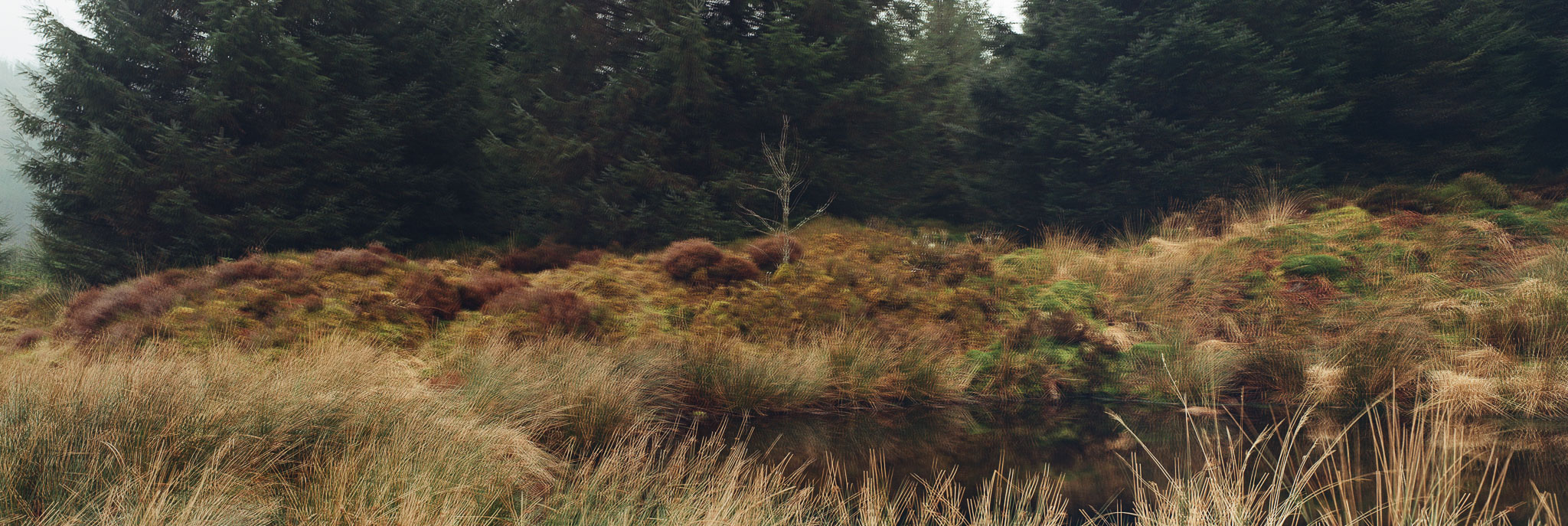
Double Exposure – Fujica G617 – Kodak Gold 200
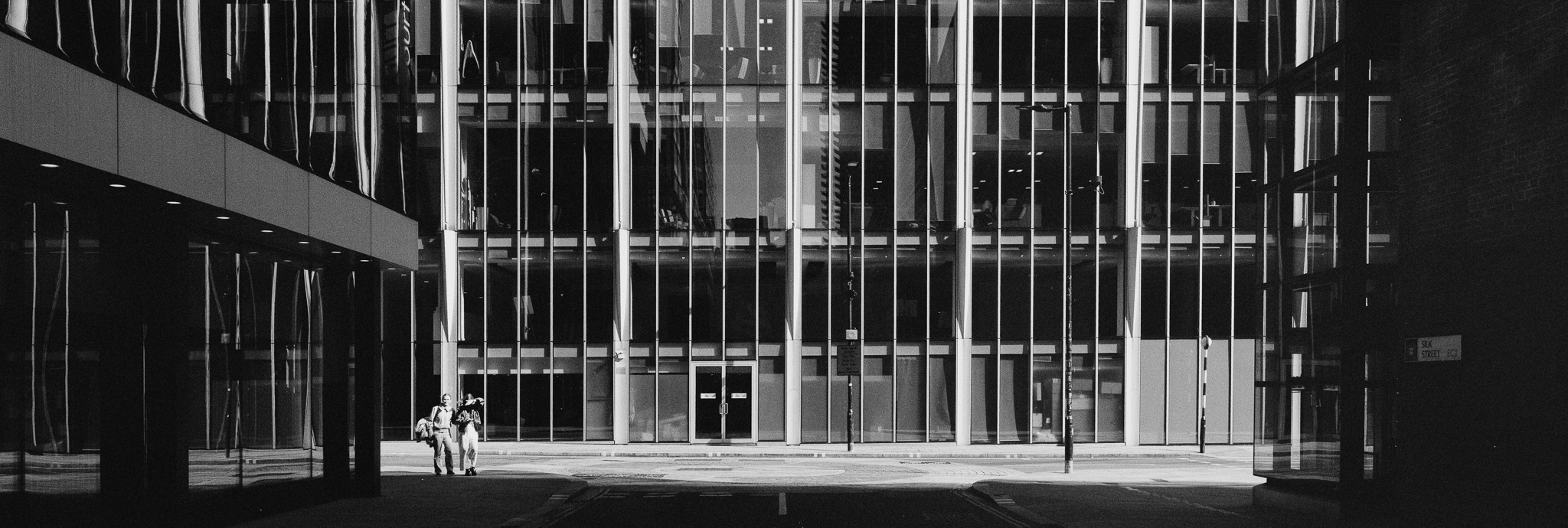
Intersection – handheld – Fujica G617 – Ilford Delta 3200
Hand-held
On our first outing to Hafren Forest I took a very careful large format approach to shooting the camera. I was pleased to see that I could compose and expose an image with it. On our second outing I went to London keen to branch out. The first thing to try was shooting handheld, because it would be fun, and also because it’s something you can’t realistically do with a panoramic view camera.
Getting the thing level is important, as wonky horizons look bad, and correcting them across such a wide aspect ratio costs a lot of negative.
I loaded up with Ilford Delta 3200 to combat the light loss from the centre grad and the light hungry lens. Then I had a bash at not quite shooting from the hip, and some portrait panorama.
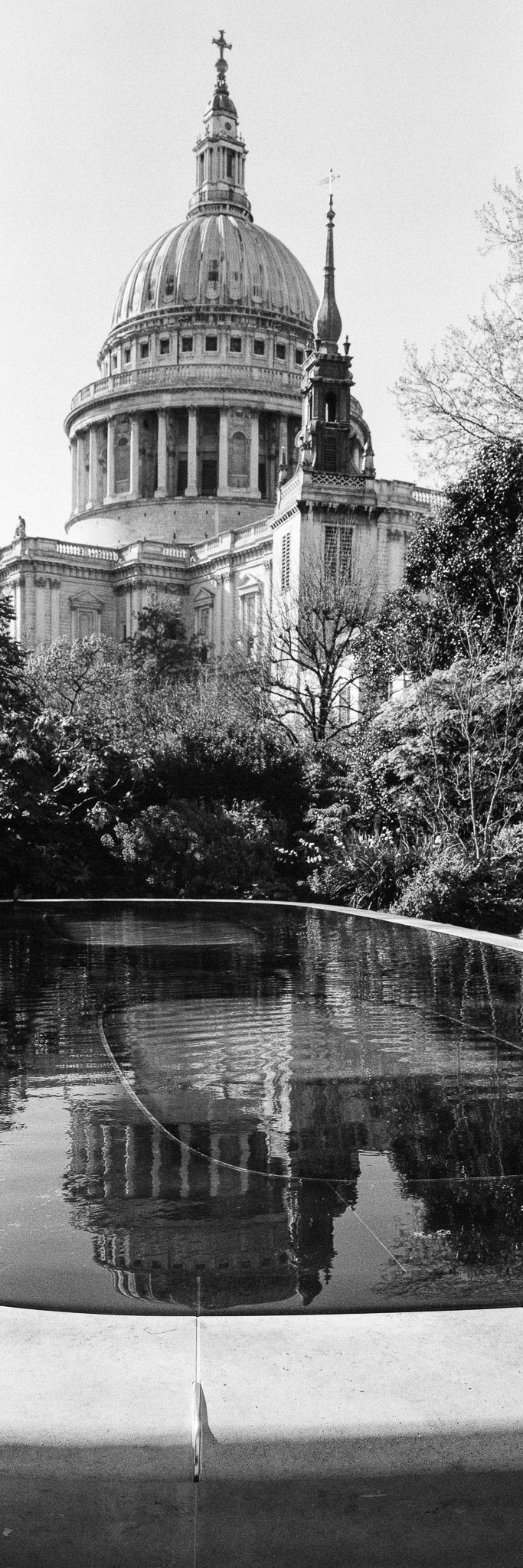
Fujica G617 – Ilford Delta 3200
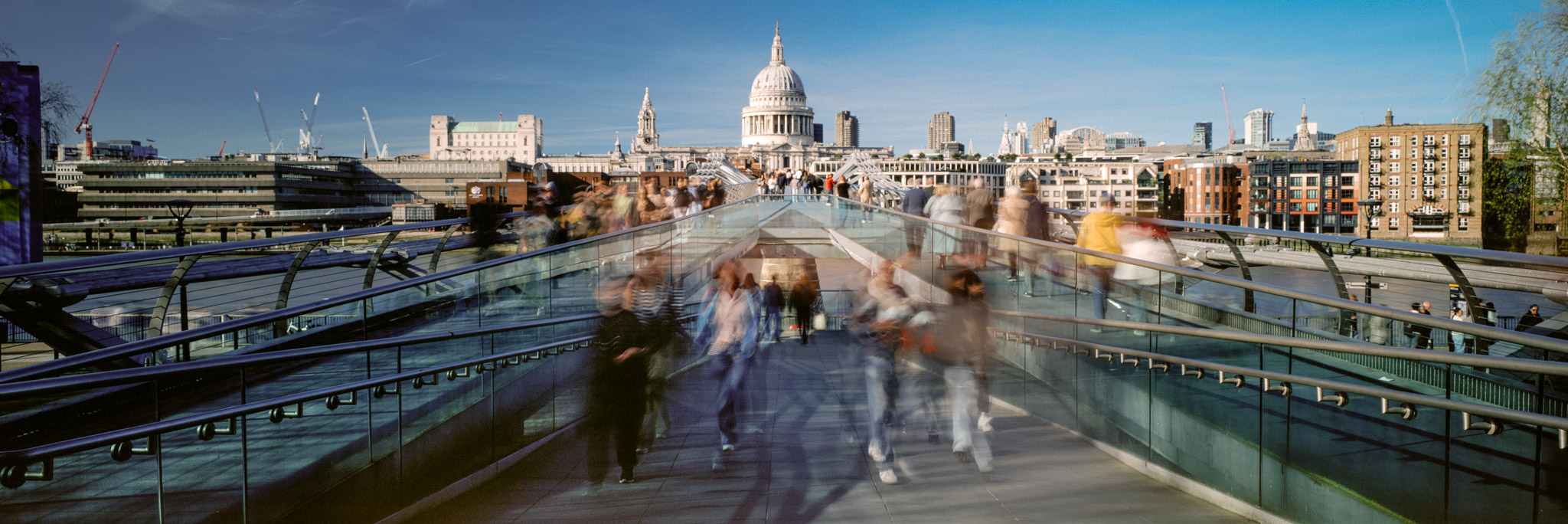
St Pauls from the Milllennium Bridge – Fujica G617 – Expired Kodak E100
The next thing to try was going further down the large format approach. The perfect opportunity arose as we were crossing the Millennium Bridge.
I took these with a Lee landscape polariser to darken the sky and to help get the movement in the people. This was a challenge as you can’t see through the polariser when it’s on the camera. I had to turn the polariser while holding it until I was happy and then maintain that position as I mounted the filter.
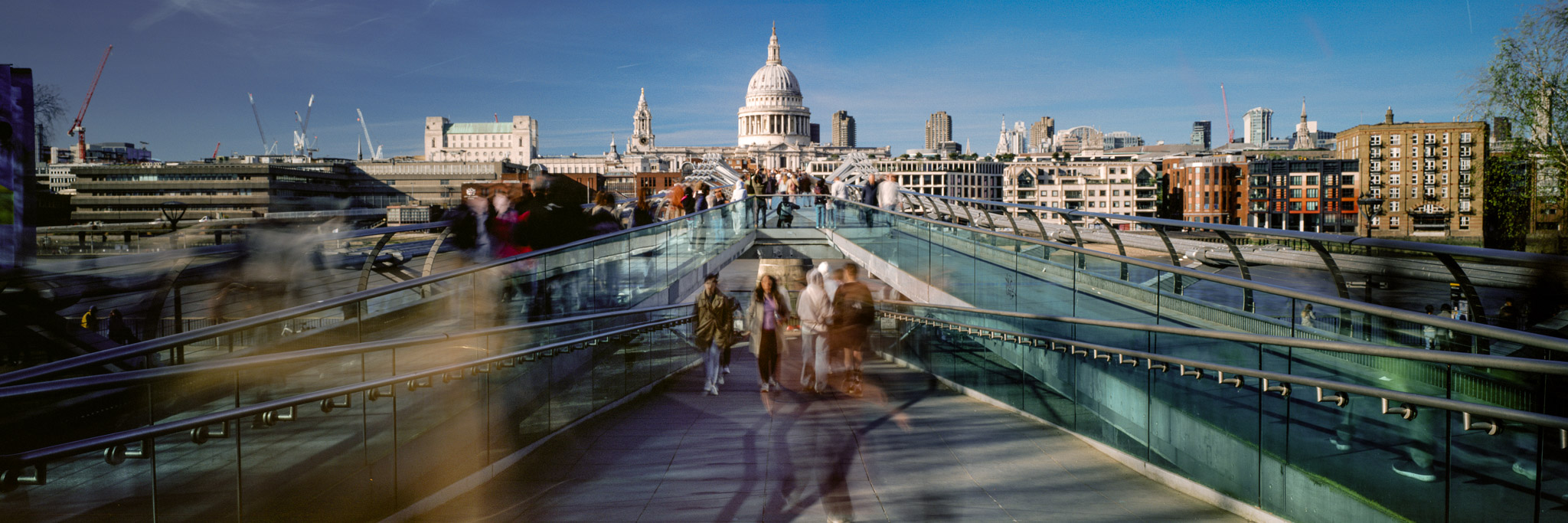
St Pauls from the Milllennium Bridge – V2 – Fujica G617 – Expired Kodak E100
Conclusions
Since the Chroma re-inspired me to travel down this road, Steve has added a technical cone to his Six:17 offering which adds 15mm of rise fall and shift. It has always had a removable back and offered a focusing screen. It was the most sensible solution to my problem then, and is even more sensible now.
The Shen Hao panoramic view camera remains as expensive a solution as it ever was. Is the little voice that tells me I should hunt one down the hammer obsessed part of my brain pining for something more familiar?
I love the format and the images for sure, I’m definitely glad I’ve had the chance to find out how much I like panoramic photography.
Is the G617 my soul camera? I don’t know. I need to take some time and curb my desire to shoot everything in cinemascope. Then the Big Fooj and I need to go on a few more dates.
The first two have gone pretty well though.
Billy Chiltong and a Rockwell Moment
The trips to Hafren Forest and London were both undertaken as a member of a new photography group called ‘Billy Chiltong’. It’s a pretty easy going photographic collective, we get together and make pictures roughly once a month. (The trip to Weston Super Mare for Big Positives was also a Billy Chiltong adventure).
It’s been great having an opportunity and a reason to make time for photography, and to have like-minded friends who want to make images too. You can see the stuff we’re making on the group’s instagram page.
I don’t have affiliate relationships but it might be useful to know that my Fujica G617 came from London Camera Exchange, some of this film came from Analog Wonderland who also developed and scanned it.