The Dream
I’ve wanted to shoot large format slide or transparency film for about 10 years. Almost as soon as I took ownership of my Tachihara, or perhaps when I saw my first black and white negatives from the camera, the idea of making something that big, with that much detail, in full positive colour became a persistent and nagging thought.
My initial excuse for not doing it was not knowing whether I could, then there was the expense, then there was where I would get it developed. I wasn’t ready to try devving E6 at home, even as my home lab gradually reduced itself to large format black and white and C4 processing.
There was the period of time where the camera’s perforated bellows stopped me using it at all, and all the while there was nagging worry about technique. Slide is much less forgiving than a typical colour negative film, and my technique could be described as ‘marginally better than slap-dash’.
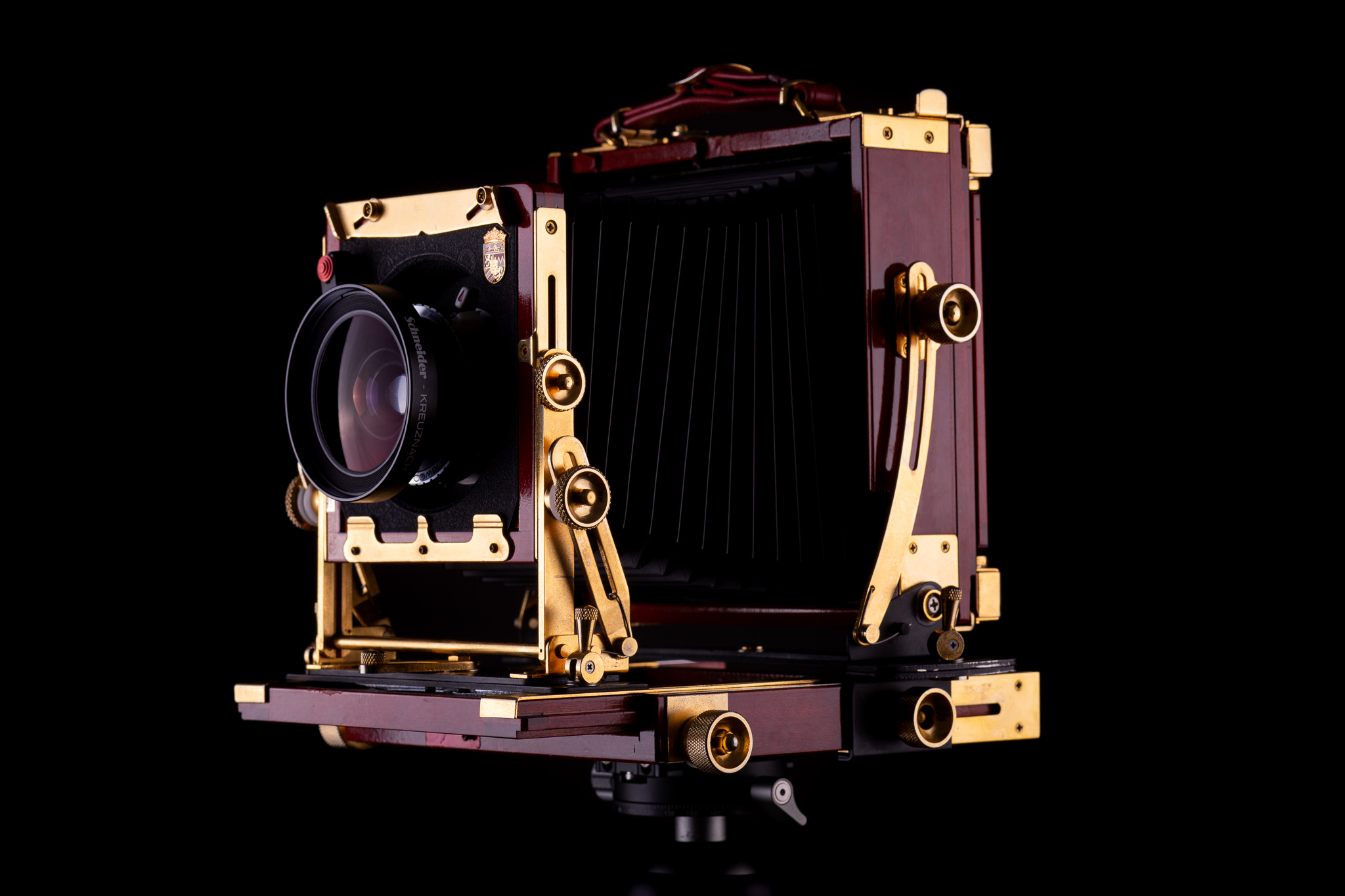
This was going to be the Tachihara’s first outing in 18 months
My Tachihara Hope, pictured with my Schneider 90mm f/5.6 Super Angulon
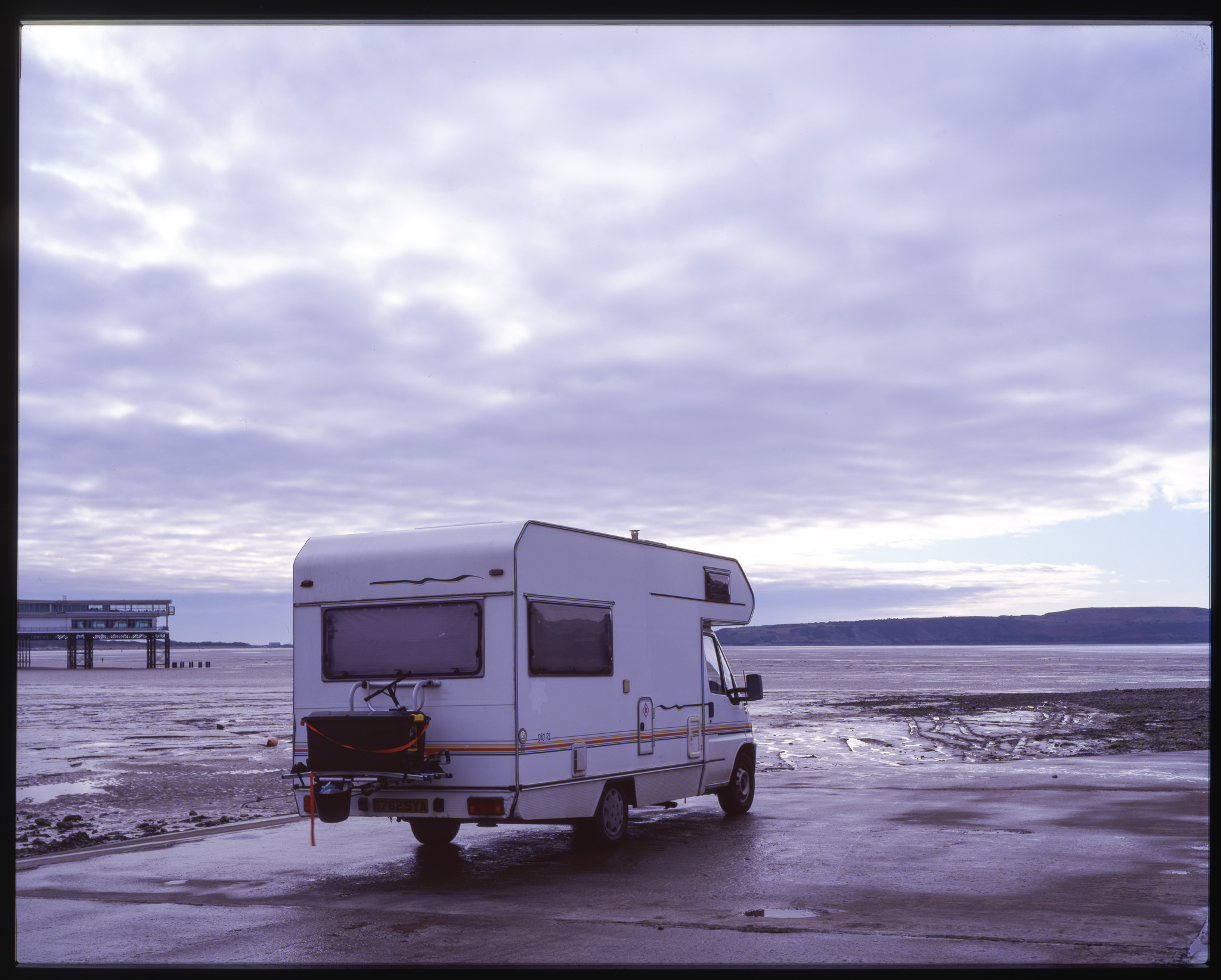
Camper on Knightstone Slipway
Frame One – Tachihara Hope – Schneider 150mm f/5.6 – Ektachrome 100
Things come about
Eventually my camera was fixed and Kodak had reintroduced large format Ektachrome to the market, and I knew a man who would dev it for me. My desire to shoot large format E6 came up in conversation with a friend and it turned out it was something he was keen to do too. We went twos on a box of Kodak Ektachrome 100 and set a date.
Had this not happened, there was a good chance that shooting E6 would be something that I would do in the summer, next year, when I have a project or a subject that would suit, in other words I would just never get around to it.
This was to be a test, an exercise, an experience, I wasn’t in this for photographs.
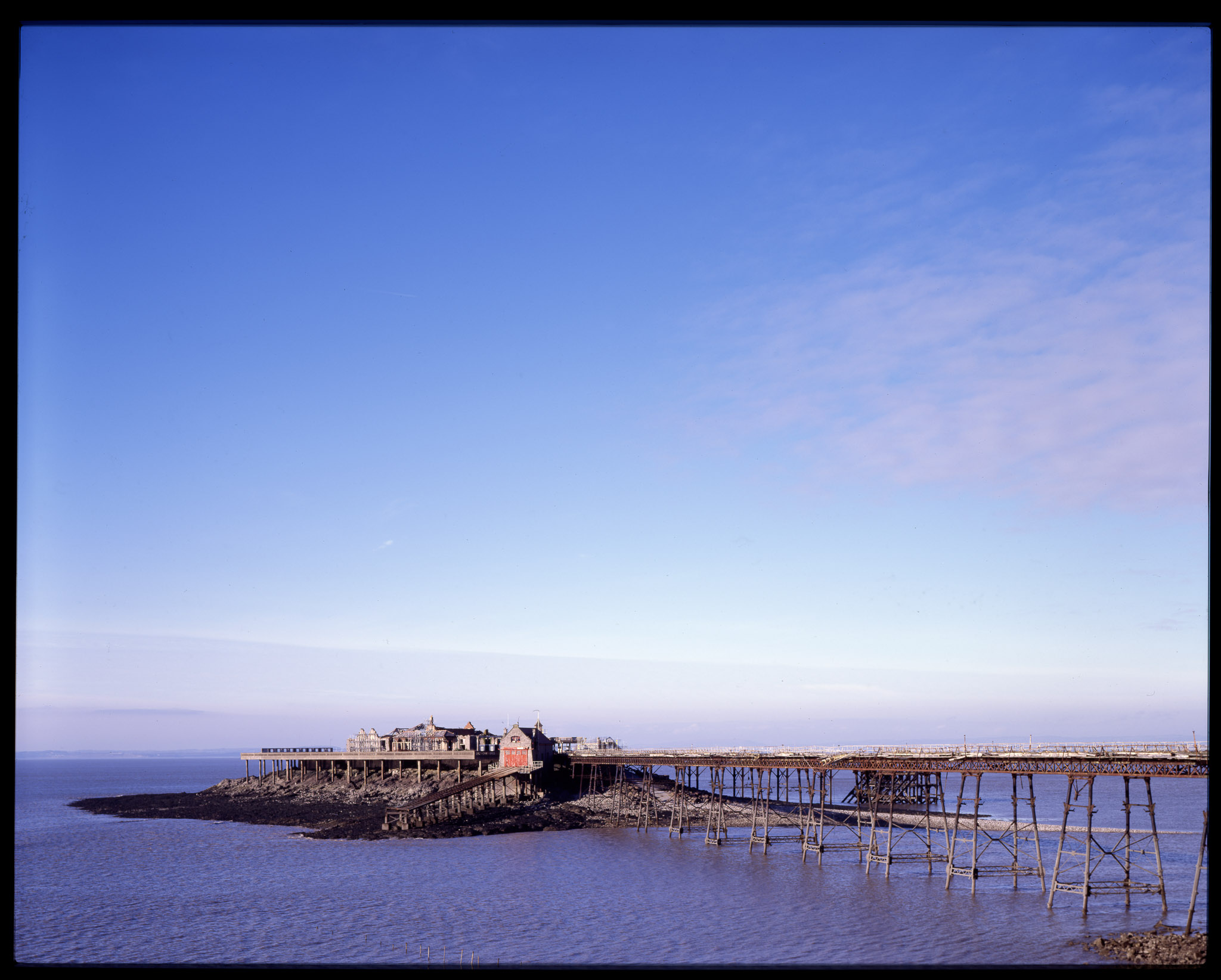
Birnbeck Pier
Frame Two – Tachihara Hope – Schneider 90mm f/8 – Ektachrome 100
The Buddy System
Photography is an odd pastime. On some levels it is best pursued alone. This removes distractions and social compromise from the equation. You can spend as long as you want pulling puzzled faces at a wall with a crack in it, without fear of judgement, (aside from the passers by).
Even when you are with a group of people, a camera can help you be on your own. There’s only room for one person on this side of the camera and this is one of the reasons I take cameras to parties.
Shooting by yourself also allows you to find the headspace that you need and to remain in it, without the fear of slowing others down, you can’t inconvenience the people that you didn’t bring with you.
The exception to this, in my case, is going out on photomissions. I’m pretty busy generally, between being a photographer, a tutor, a lecturer, a blogger, dad and husband, not to mention the close personal relationship I’ve built with the dishwasher. These commitments make it hard to get out and make pictures just for me. [Cue a tiny violin solo.]
Having a friend to go with, and a date in the diary means not only do you have some moral support when you’re out and about, but you have another brain you can raid for info. There’s someone that will be cross with you if you don’t go. They make you get up early and pack a bag, like a gym buddy that means you actually do it.
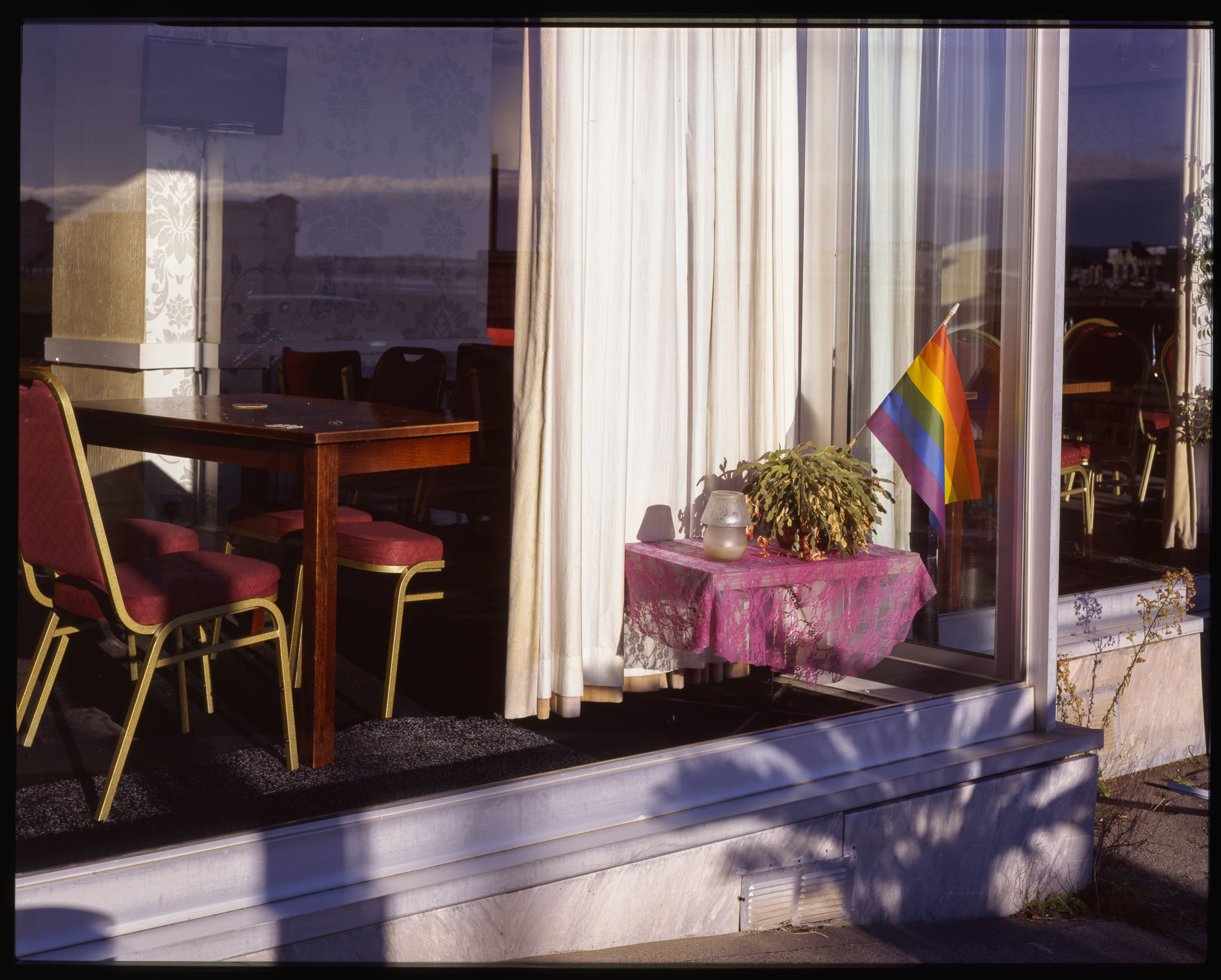
Lounge Window
Frame Three – Tachihara Hope – Schneider 150mm f/5.6 – Ektachrome 100
The Mission
Our mission was to shoot ten sheets of Ektachrome 100 in Weston-Super-Mare in a day. Having any film left over would add friction and complexity to the situation, like leaving a wounded man behind, or falling foul of relativity and returning in 2062. Much better to get them shot, send them all off, get them all developed and then regroup.
I spent the day metering with my Sekonic, torn by a weird ambivalence, a sort of devil-may-care seriousness that wanted to get the sheets exposed, but also didn’t want just waste the film. I told myself I was in it for the experience rather than the pictures, and yet I fretted about whether I was using a sheet better suited to something around the corner.
I thought of Joel Sternfeld, touring the US in the late 70s and early 80s with only enough film to make two exposures a day… then I stopped because his two a day eventually became American Prospects, and that was pressure I didn’t need.
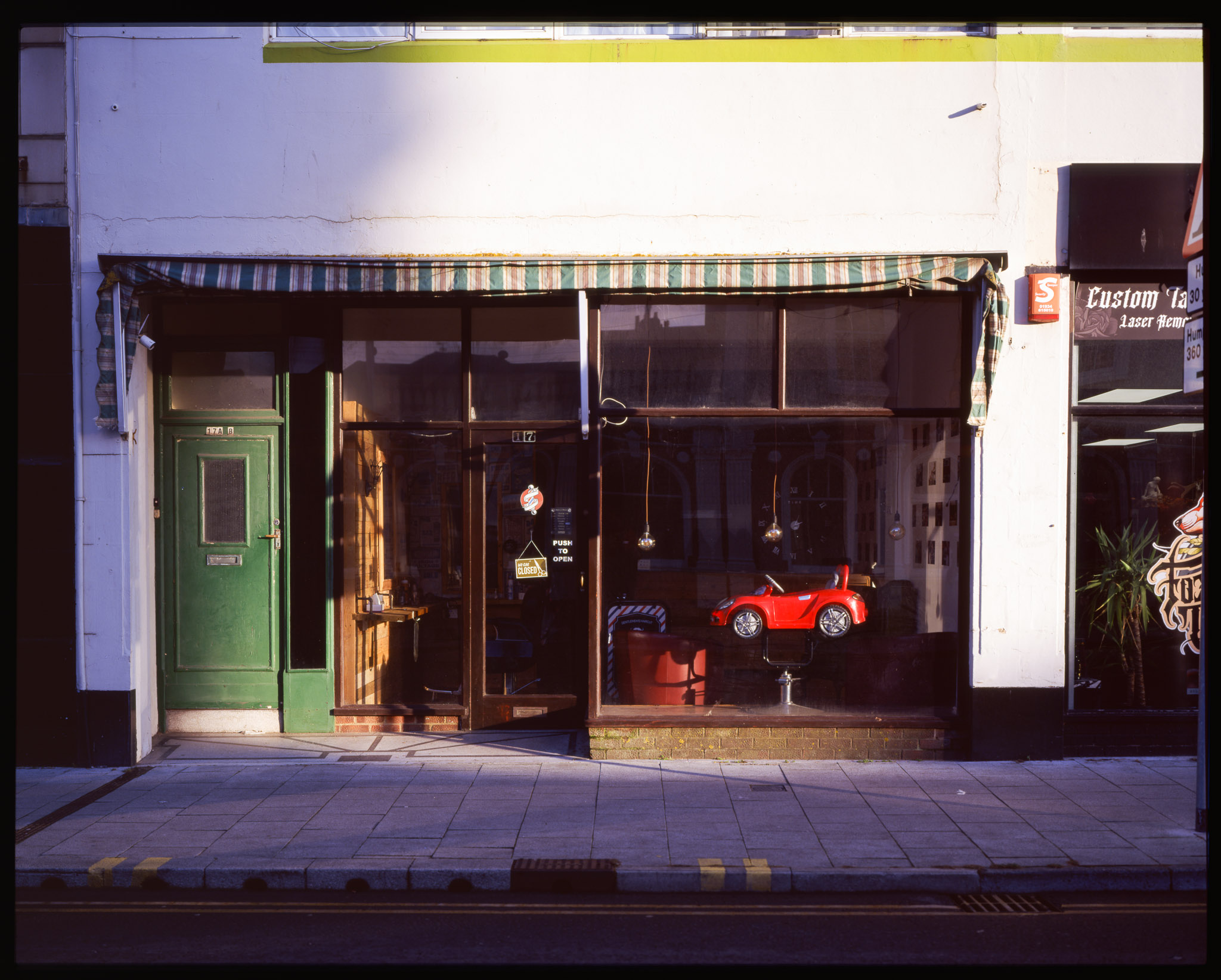
Barbershop
Frame Four – Tachihara Hope – Schneider 150mm f/8 – Ektachrome 100
Conclusions
We managed it, I rushed my last exposure, manipulating the camera’s standards to try and force a composition that was just going to have the camera’s shadow in it. By the time I’d finished it didn’t look like the image I’d pre-visualised, but I took it anyway. I also chose to stand to the right of my camera, rather than the left, thus thrusting my shadow into the frame. This was the only real failure of the day, and the day really was great fun.
Having both achieved our goal, we despatched our film up to Mike at Tanner’s Bank Darkroom and he did a cracking job of developing the images.
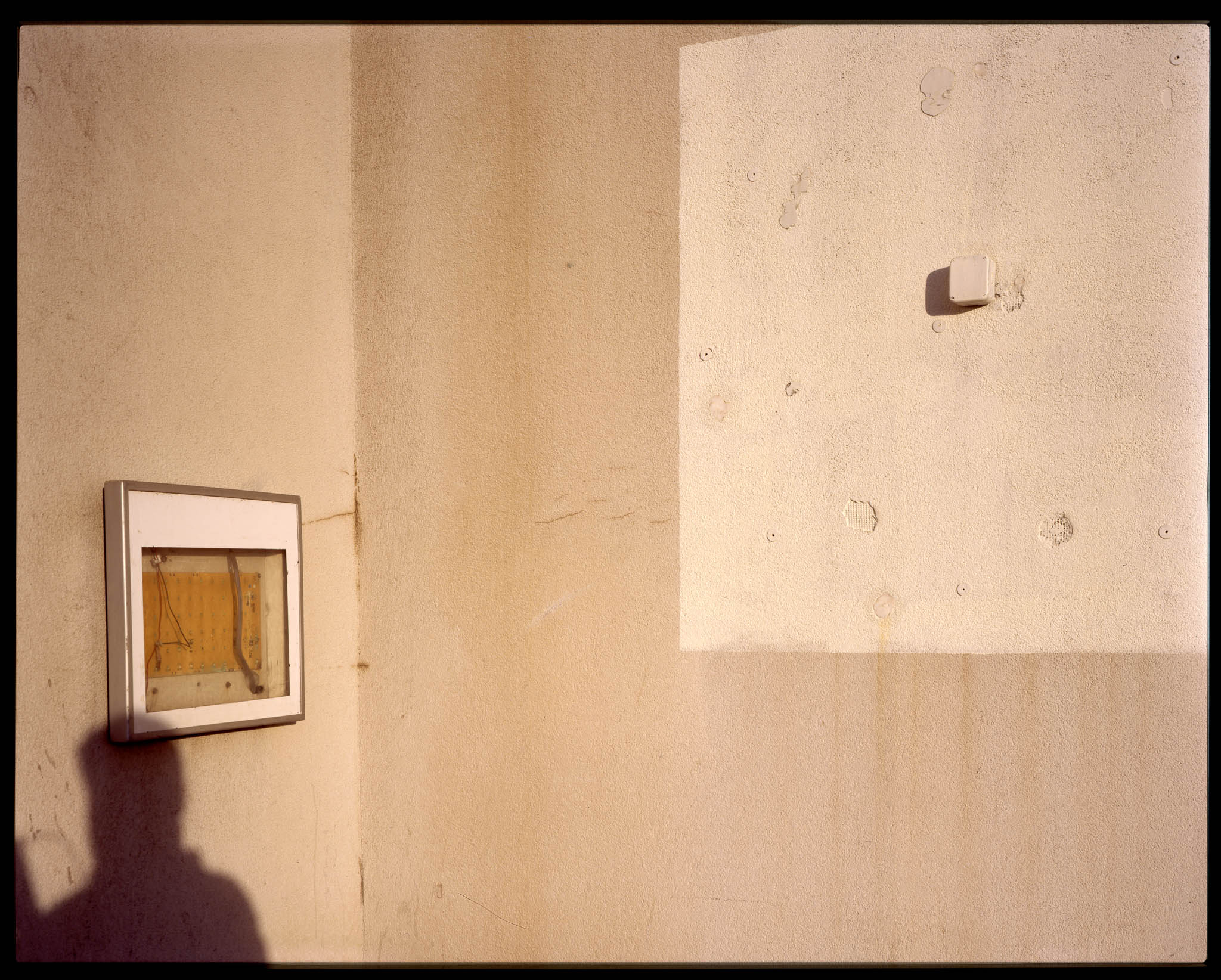
The Idiot’s Shadow
Frame Five – Tachihara Hope – Schneider 150mm f/8 – Ektachrome 100
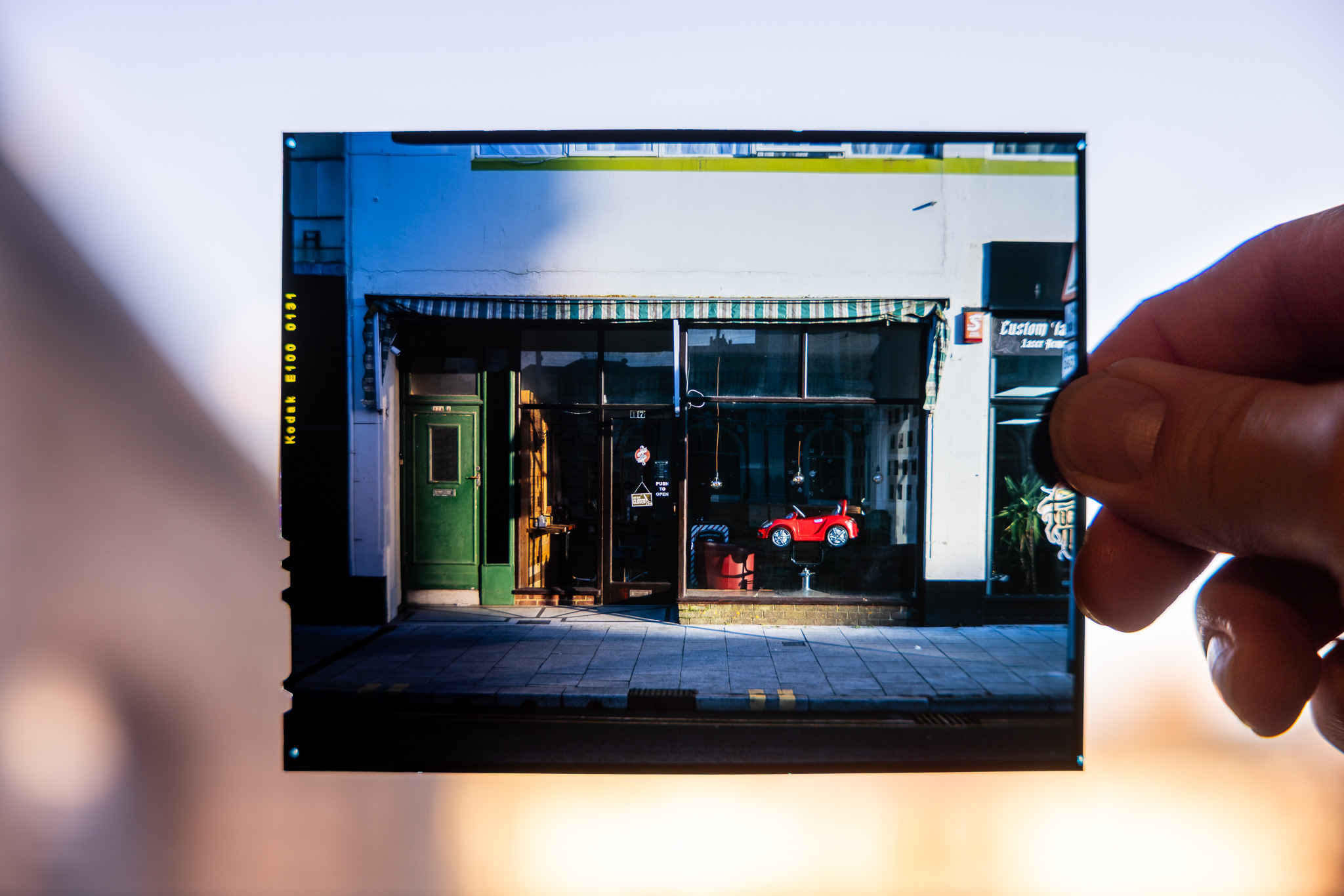
I was right, there is something magical about holding a sheet of 4×5 film up to window light and seeing those colours filtered back at you. There is something special about holding something that feels like the definite article, holding the actual material that was altered by the light in that space in that time.
For someone who produces a lot of digital images for others, there’s something doubly special about the tangibility of large format transparency film shot for oneself.
I scanned mine at home, deciding to go for it and producing some whopping 180 megapixel .tif files, mostly just because I could. As always there was plenty of dust to clone out, but I have to say, I’m both happy with the experience, and with the pictures.
I had a really nice day out with friends, laughed a lot, and talked about cameras too much. It was great. We had such a good time that we’ve already had our second meet up, and have our third in the diary. (More on that soon).
Beyond being right, having fun, and liking the pictures I made, I’m really happy that I’ve done it. It’s possibly a little daft to think of this as a life goal achieved, but it is something that I’ve wanted to do for ages.
The interesting thing is that there is no reason not to do it again. Looking at the colour film landscape, E100 is actually cheaper than my go to colour sheet film (Portra 400) and a similar cost to a few of my second choices. Developing doesn’t cost that much more, so there’s no reason not to do it again.
While I wait for the next box to arrive I content myself with occasionally taking these out of the packet and holding them up to the studio window. Mike at Tanner’s Bank told me that E6 large format could be addictive, I can see why.
Rockwell Moment
I don’t have affiliate relationships but it might be useful to know that my Tachihara camera from London Camera Exchange, as did my film in this case. These images were developed by Tanner’s Bank Darkroom and scanned by me.