
Some Thoughts on Mobile Phone Photography
As a working photographer, a photography tutor, and retail assistant in a camera shop, many people assume I bear an antipathy towards mobile phone photography.
People will tell me that their cellphone camera is enough for them, in either a bullish or sheepish fashion.
I’m regularly told either defensively or aggressively that: “What mobile phone cameras can do these days is amazing.”
It’s as if people see me as a typewriter fetishist, quietly railing against the ball-point pen, determined not to have my Hasselblad undermined by people with iPhones.
This is not the case.

MAN ON BEACH – GOOGLE PIXEL 3XL
Democratisation
It’s over twenty years since I listened to a friend at college decry the “APS system” [sic] as ‘photography for idiots’. Whatever the pros and cons of APS, (and I wasn’t a fan either), he was continuing a tradition as old as photography.
As each technical advance has reduced the amount of knowledge required to make pictures, a tranche of the photography world has heralded it as a cheapening.
Whether it’s Kodak’s Brownie camera, “You push the button, we do the rest”, APS, or the shift to digital, there are always those who feel that photography has been hurt by an influx of new photographers borne on the back of new technology.
I’ve tried to stay aware of the advantages I’ve had in photography, and to regard progress as evolution as opposed to defamation. I haven’t always been successful, but I try.

POOL – NOKIA 6630

AT THE RACES – PIXEL 3 XL
Balance
When I’m teaching photography I talk a lot about balance. When you’re making a photograph, you have to balance the needs of the photograph against the light that you have.
Whether it’s choosing to give up some depth of field in favour of freezing the action, or a noisier image over camera shake, we make these choices all the time.
When I’m out walking, I have to balance the length of time I dedicate to a photograph with the depreciating enthusiasm of whomever I’m out with, and whether having to carry the tripod is going to limit the adventure.
All life is compromise and this balancing act extends to the technology itself. Each investment in software does not go into glass, each investment in hardware is money not spent on travelling and making pictures.
It makes no sense to use a large format camera for everything, it’s hard to be responsive when there are some many things to adjust. This flexibility is a boon however, when you’re photographing architecture.
Snapshots of your child running with a kite benefit from some speed and manoeuvrability, whereas corrected perspective is less of a priority.
The point is that most cameras have a sweet spot; somewhere they make sense. Mobile phone cameras have their strengths and weaknesses like any other.

T-REX ATTACK – GOOGLE PIXEL 3 XL
Phony Camera
Mobile phone camera sensors are small. As a result they collect less light and have to work hotter and with wider apertures to make pictures.
Smaller sensors can achieve greater depth of field at an equivalent aperture to their larger-sensored compatriots, which means that they are easier to use for close up photography.
This deeper depth of field also negatively affects their ability to blur the background in portraits. (Hence the multiple different software options that are included in portrait mode; a mode I use everyday).
The obvious thing that camera phones have in their favour is that they are in your pocket, in your hand, next to you at the pool.
It’s a cliche to say that the best camera in the world is the one you have with you but, as someone who rarely has his macro lens with him, and rarely makes macro images can attest: having it on you makes it easier to use.

FATHER AND SON – GOOGLE PIXEL XL
Photography comes home
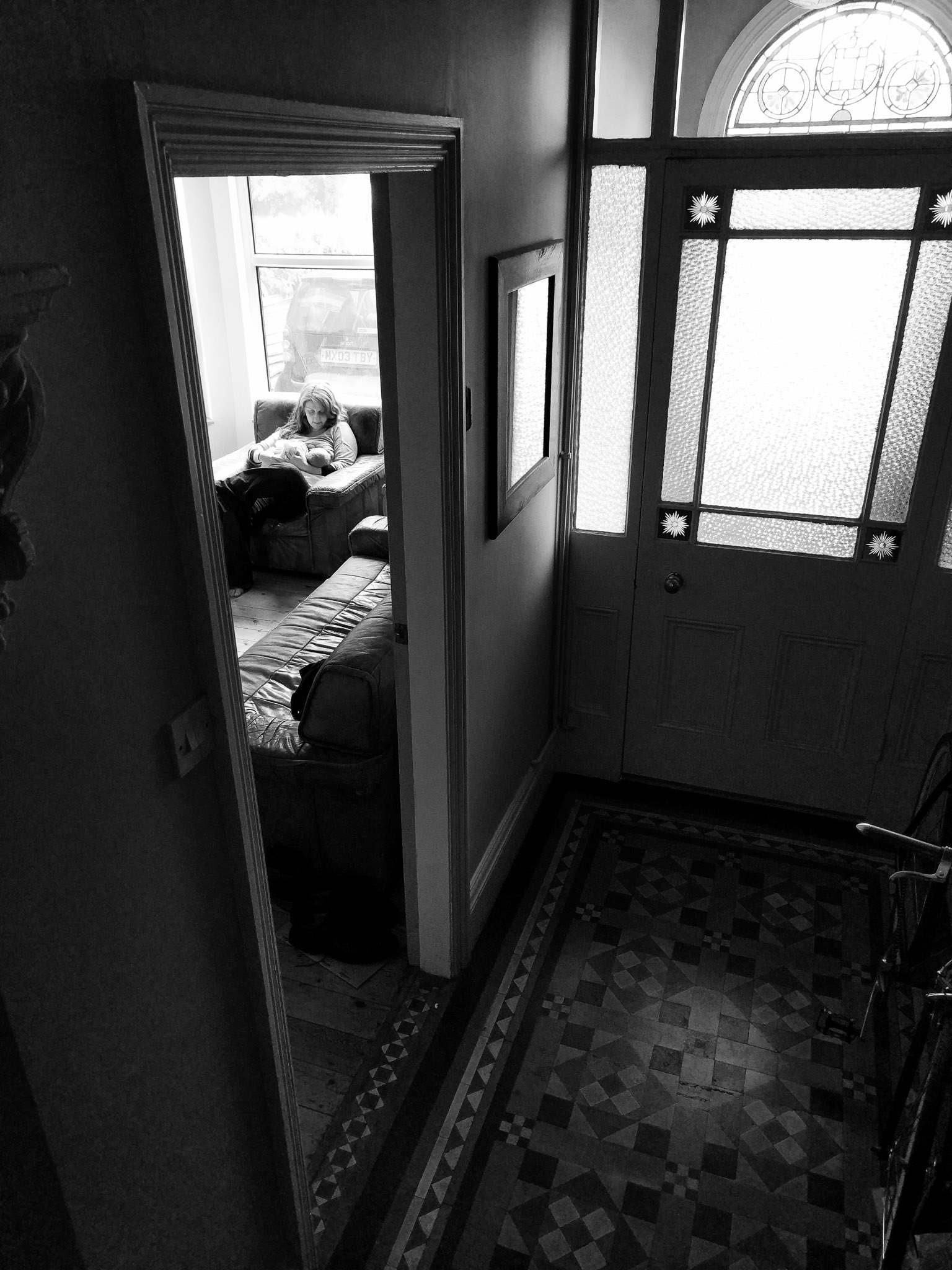
The reason I’ve been thinking about this is that 2020 has been a year of photography in the home.
Stripped of much of my work and the ability to travel freely, three bouts of self-isolation, one of which was spent in bed with COVID 19, haven’t prevented me from making photographs, but it has changed the photographs I’ve been making.
Forced family time has proved by turns to be both challenging and delightful, and I’ve carved out some time for experimentation where I can. All the while my cellphone camera has been documenting family life and maintaining connections with those I can’t be with.
It’s a stills camera grabbing pictures of our life together.
It’s a video camera, recording the Intern’s nutty dash across the park, or slow-motion video of his grin on a swing.

INTERN ON THE STAIRS – GOOGLE PIXEL 3 XL
Conclusions
It’s no coincidence that after years of trying to decide which compact camera would suit me best, it was the year I’ve spent at home when I bought one.
It’s also been the year that the new compact has been sat on a shelf, charged and ready when I’m in the garden and I want to make a photo.
Marketing departments are eager to boast about what their cameras are capable of, and at least two have been caught using pictures taken with DSLRs to promote their cameras.
The over use of Pro or Professional to denote capability and quality of result has become de rigueur within phone camera marketing, which is both tiresome and and unhelpful.
No camera can produce Pro results, that’s down to the photographer. Professional simply means “has a value in a market place”, and does not mean objectively good, meaningful, or export”. There are all sorts of ‘professional photographers’, and all sorts of amateurs too.
Within days of getting my last handset, my soon to retire Google Pixel 3 XL, I had set it up to sync DNG/RAW images files back to my Lightroom library for editing. The files from cellphones are many times more tweakable than they used to be, but they are still (understandably) not a patch on the files my DSLRs produce.
As good as the images appear on a screen, they struggle to fill a print with detail and substance.

SATURDAY – PIXEL XL
The point is that cameras have their strengths and weaknesses, as do photographers, as do photographs.
The apparatus you use has a bearing on the product that you create. When I tried to write a novel, I didn’t do it on a pad with a biro. When I write a shopping list, I don’t feed paper into my vintage typewriter.
My camera phone on the one hand is a notepad that snaps pictures of posters I don’t want to memorise or a plumber’s phone number on the side of their van. It’s also a camera, like all of my others.
The plush high-end compact that I bought in the summer is on borrowed time. For every outing that warrants taking a camera, there’s a better camera I can take. For everything else my phone serves me quite nicely.
In a few weeks my new mobile phone will arrive. Once again I’ve looked at the landscape, eschewed the brands I refuse to use, and ordered the best camera that also takes calls, sends emails, holds my to do list, and keeps me on schedule.
I’ve also allowed myself to be seduced by marketing material. (I’m genuinely excited to play with Apple ProRaw).
The true humanism of photography is in its democratisation. All cameras are tools to be used, all photography is about image. There are no points for making bad images with complicated gear. A meaningful image is a meaningful image, no matter how it’s created.
The fact is, I take a lot of photos with my phone and every now and again I make a photograph.